


Baseball's Unique Home Field Advantage
- Aug 24, 2017
- 7 min read

“Home field advantage” is a phrase that applies to all five major team sports played in North America (football, hockey, basketball, soccer, and baseball), commonly implying the extra support a team receives when playing in front of their local fans – as well the heightened pressure visiting teams might feel as they are jeered constantly from the audiences.
Home field advantage has been proven to have an effect on the game, as the noise level of the home crowd (often cued by cheers or music from the stadium’s PA system) plays into the feel of the match. Century Link Field, home of the Sounders and Seahawks, prides itself as being one of the more difficult places for teams to visit, as the screams from the Seattle fans echo around the place at a volume that’s louder than (so they say) what you would find at any other stadium.
Yet home field advantage in baseball is different. Yes, there is definitely the “fan support” element mentioned above, which places the sport right up there with the rest of the Big 5 – but playing at your “home” in baseball brings extra factors that are not found in these other sports.
First, the actual rules of baseball contribute to home field advantage, as the home team always bats second, giving them the best opportunity to win the game on offense instead of “holding on” through pitching. But there is a physical side of this coin as well – and it is this side that I find most interesting. For indeed, a baseball team that plays at home has home field advantage… because no baseball stadium is the same.
Now, I have absolutely nothing against the other main professional sports played in America. I love soccer (go Sounders), I try to look past the occasional horrors of the NFL because I love to watch the Seahawks, I fell for the Milwaukee Bucks when the Sonics were stolen (Marquette for NCAA), and, while I couldn’t name a single player in the NHL right now, I love listening to Doc broadcast Stanley Cup games.
But none of these sports do for me what baseball does – and part of my obsession with America’s Pastime comes from the variety that can be found in its ballparks. You see, baseball is a sport that does not have set dimensions. The only thing that must be the same in each stadium is as follows: the bases must be 90-feet apart and the pitcher’s rubber must be 60-feet-6-inches away from home plate. After that, anything goes.
This autonomy in design has allowed for a true uniqueness to shine through in every one of the thirty cathedrals that host our country’s pastime. With no restrictions outside of the two requirements mentioned above (and a couple small things such as batter’s boxes and dugouts), baseball stadiums stand as products of creativity and freedom of design. Some are very basic; some are incredibly unique – but all contribute physically to the gameplay that proceeds at each, thus emphasizing the aforementioned home field advantage. How a game plays out more often than not varies depending on the park it is played at.
Below are two wonderful, wonderful info-graphics from MLB.com that give a good idea of the many dimensions of baseball fields. Take them in, and we’ll continue after.

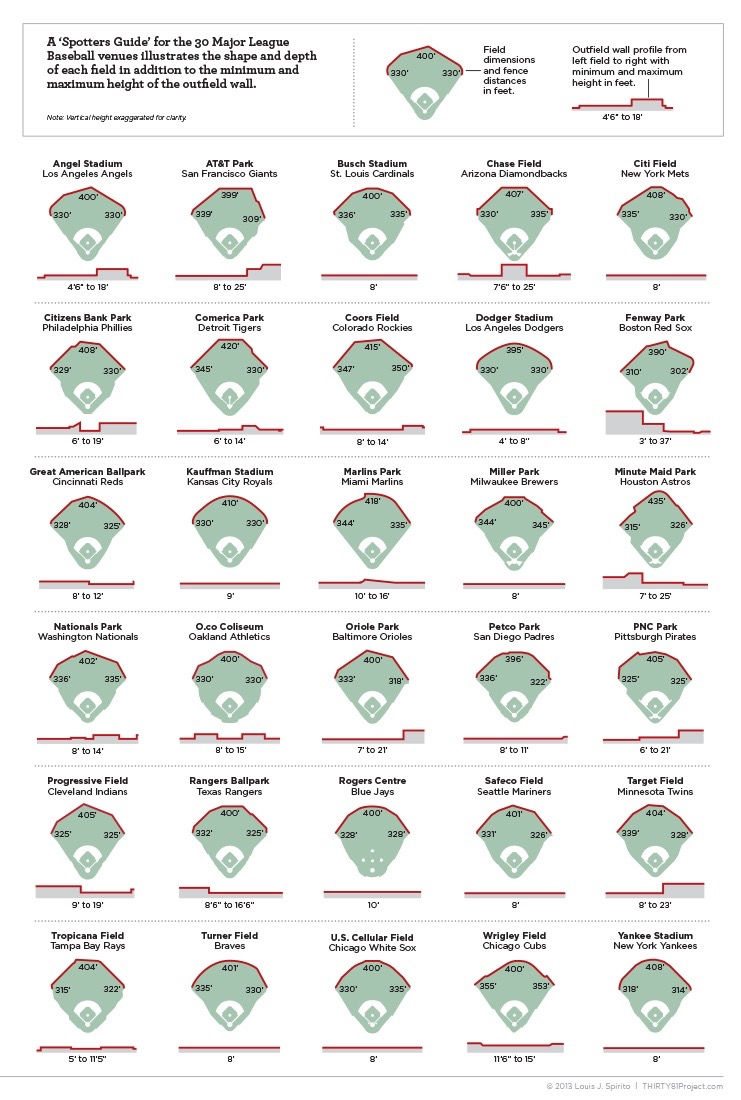

Perhaps the most recognizable element of ballpark variety is seen in a stadium’s distance between home plate and the outfield walls. Some stadiums are deep, such as Chicago’s Wrigley Field (where it is over 350-feet to both left and right), Pittsburgh’s PNC Park (which has the deepest distance to the left-center “power alley” at 410 feet), or San Francisco’s AT&T Park (right), where it is an astounding 421 feet to the right-center power alley. Up until this year, Houston had the deepest center field (436 feet), but the removal of Tal’s hill has led to Detroit’s Comerica Park taking this title (420’). Ballparks such as these are known as “pitcher’s parks,” because the deep fences allow for more batted balls to be tracked down by outfielders, resulting in outs instead of home runs.
But there are plenty of “hitters parks” as well. The smallest stadium in all of MLB is Boston’s Fenway Park, which checks in at 310-feet to left, 390 to center, and 302 to right – each of which is the shortest distance in their respective direction in the bigs. Other shallow fields include Tampa Bay’s Tropicana Field (315’/404’/322’), Baltimore’s Camden Yards (333’/400’/318’), and New York’s Yankee Stadium (319’/408’/ 314’). The particularly short porch in right at Yankee Stadium has earned the ballpark the comical title of “The Great Whiffle Ball Park in the Bronx” for the way that some balls – which should be routine fly-outs – leave the yard in a hurry. I’ve seen dingers hit at that park that feel more like accidents than accomplishments.
Fence height varies drastically as well. A few ballparks, such as Milwaukee’s Miller Park or Seattle’s own Safeco Field, have a fence that maintains the same height throughout the outfield, normally standing at 8- or 9-feet tall. Yet as was the case with fence distances, so too is this symmetry in height a rarity among stadiums.

The shortest wall in MLB is at Fenway (left), which stands at 3-feet tall in right field, and has caused many an outfielder to flip over it when trying to make a catch, as their legs are cut out from beneath them. (Jay Buhner remembers this well). The corner sections of the outfield wall in Angel Stadium are also extremely short, at roughly 4-feet-6-inches next to both foul poles.
Many stadiums, meanwhile, have tall fences. The highest right field wall in baseball can be found at AT&T Park, which stands at 25-feet from the pole to the power alley. In center, the highest wall is that of Arizona’s Chase Field: also 25-feet tall, but 407 feet away from home plate (good luck hitting a ball over that thing). And to left – well, nothing tops Boston’s famed “Green Monster,” which looms at 37-feet high and stands as a pitcher’s nightmare and a batter’s Christmas morning.
Some walls are padded, some walls are brick…and Wrigley Field’s is covered with ivy.

Oh, but ballpark variety does not stop there. We have discussed the varying dimensions in fair territory – but baseball’s uniqueness is not restricted to within the lines. Baseball is the sport that incorporates the out-of-bounds into its gameplay more than any of the other Big 5, which means foul territory differs greatly as well.
Some stadiums have little foul territory, such as Wrigley or (again) Fenway, which means that pop-ups just to the side of first-base will normally drift into the stands, giving the batter another chance.

Other ballparks have a ton of foul territory, such as Detroit’s Comerica Park or St. Louis’ Busch Stadium…and my god, it seems that there’s more grass growing outside the lines than within them at the Oakland Coliseum (right). A game played at one of these fields may mean that the same pop-up that drifted foul at Wrigley & Fenway would be an easy out here.
And just when you thought that every stadium’s diversity came in its dimensions – fair or foul – you then realize that there’s even more that contributes to this variation of gameplay, depending on the field. Toronto’s Rogers Centre is a turf diamond, which means that a ground ball hit here has a far greater chance of skipping through the infield for a base hit than it would on a grass field. Comerica Park has a strip of dirt that leads from the pitching mound to home plate, the lip of which often cradles bunts directly in front of the catcher, unless directed elsewhere. Tropicana Field (below) has catwalks that often obstruct the path of the ball – but they are considered in play, so (like the Ners experienced last week), the fielder must react to the ball’s new direction. And just up until last year, there was a hill – yes, a hill – in center field at Houston’s Minute Maid Park.

So what does this all mean? Well first, the autonomy in design makes visiting ballparks as a fan a very fun experience, for the unique dimensions of each often bleed into the individuality of the rest of the stadium. Once upon a time, a few of my friends and I packed everything we knew into the back of an old Volkswagen Camper and took off to try and see a game in every MLB stadium – an endeavor that was interesting because each field was simply so different. Different distances, different fence heights, different foul grounds, different terrains…they all contributed to the unique feel of each ballpark and made each stop along the way feel distinct from the others. This intrigue is not found in other sports – take an NBA arena for example – simply because the courts (like a football pitch, American football field, or ice-football rink) must be the same dimensions. I have seen NFL games in other stadiums – and while it was super fun, it had nothing on seeing other baseball stadiums because the field is the exact same as every other one in the sport.

To prove my point, here is a fun game to play: find an image that removes all labels and sponsors from an NBA arena or NHL rink (there’s an example on the left), and then try to guess what venue it is. It’s difficult! Even with the NFL, which has a decent amount of stadium variety, venues can often look the same because the field it surrounds must always be the same. But I’ll bet you could identify a baseball field.
These all contribute to make home field advantage a truly tangible thing in baseball. While the intangible advantage of the crowd is definitely there as well, playing in your home stadium brings with it a familiarity of that park’s dimensions, terrain, etc.
Think of how the Mariners must prepare when visiting a place such as Tropicana Field, where the turf diamond and hanging catwalks are completely foreign. Think of how they feel right now as they head to New York, with nothing but fly-ball pitchers slated to start in a stadium that’s built for dingers. And then think of the comfort the team feels when they return to the friendly confines of Safeco. Here, Ben Gamel knows how a groundball down the line will carom off the wall as it juts out behind first, Mike Zunino knows how much room he has to field a pop-up behind home plate, and Ariel Miranda (sometimes) knows he can get away with a high fastball in hopes of inducing a fly out.
So next time you venture down to Safeco – or whatever field you call home – and scream cheers to show that you have your team’s back, take a look around at the stadium…and recognize that your ballpark has your team’s back as well.


Comments