


Does Best Bullpen = Best Team?
- Apr 13, 2017
- 12 min read

On April 9, the Mariners orchestrated one of the worst bullpen collapses in recent memory, blowing a 9-3 lead in one inning. I don’t want to take you down any more of that storyline. I’m cringing even thinking about it.
The early return on this year’s bullpen is unclear. There have been some bright spots, like Dan Altavilla, and some not so bright spots, like anything associated with Nick Vincent.
However, it’s become increasingly apparent that a good bullpen can be the key to success for a championship-caliber squad. Last year’s World Series participants, the Cubs and Indians, both had extensive weaponry in the ‘pen to get them to that point. The Cubs had flame throwing bad person Aroldis Chapman surrounded by big arms like Hector Rondon and Pedro Strop, while the Indians deployed the dominant Andrew Miller as a bridge reliever with Bryan Shaw and Cody Allen as capable shutdown guys around him.
But have the Ners ever had an elite bullpen like those two squads? They’ve certainly never achieved the level of postseason success those two did, but that doesn’t mean they haven’t had some fine relievers over the years, especially in the heyday of the mid-90s and early 2000s. One would think that the best Mariner teams in history also had the best bullpens, correct?
Strangely, as I found in my research, this is not the case. In fact, the Mariners’ best bullpens over the years have not always correlated to a playoff appearance. Over the course of this article, you’ll see what I mean.
I’m going to start this experiment in 1995 because I’m discussing playoffs and bullpens, and that first thing didn’t happen until ‘95. (Apologies to Bill Swift, who had an absurd 3.7 WAR season in 1991).
I started by looking at the four Mariner teams ever to make the playoffs (that sentence was as painful for me to type as it was for you to read, I’m sure). Beginning in the miraculous, magical, Seattle-baseball-saving 1995 season, the Ners went to the playoffs four times in seven years, after not making it for nearly two decades prior.
(Note: All stats from here on out are courtesy of the beautiful Baseball Reference.)
For each season, Baseball Reference singles out the five relievers on the team who made the most appearances out of the bullpen. I’m generally going to use just those five, unless someone else super crucial in one way or another is on the outside looking in.
1995
Let’s start with the magical 1995 season. People forget (or in my case, just learned) that this season was actually only 144 games, because the strike that cancelled the 1994 World Series carried over into April.

Closer: Bobby Ayala and Norm Charlton
You would think that the first playoff season in franchise history would feature a fairly steady, rock-solid bullpen anchor for the ninth inning. You would be wrong! 25-year-old Bobby Ayala certainly led the team in saves on the season with 19, but he also blew eight saves, had five losses and boasted a 4.44 ERA. That’s very bad!
Curiously, the Mariners were able to find their late game shutdown guy, Charlton, after he was released by the Phillies on July 10. Charlton, who is featured in this newsletter’s “Where are they Ner,” missed all of 1994 due to injury, then came back in 1995 and was bad in Philadelphia, posting a 7.36 ERA in 22 innings and also getting drilled in the head with a line drive.
After the Mariners picked him up on July 14, he was a revelation, posting a 1.15 ERA across 47.2 innings. In 30 appearances for the Ners, he finished 22 games and recorded 14 saves, taking over Ayala’s job late in the year.
Best Reliever: Jeff Nelson
In the season that put the Mariners on the map, the original Nelly (sorry Cruz) was fifth on the team in WAR – as its set up man – trailing only Randy Johnson, Edgar Martinez, Tino Martinez and Ken Griffey, Jr. Nelson logged 78.2 innings over 62 appearances and posted 2.17 ERA and a stellar 11.0 strikeouts per nine innings.
By WAR, it was Nelson’s best career season by far with a 2.9, and he was a potent late inning force.
Other relievers of note: Bob Wells, Bill Risley
Risley (who?) and Wells were the only two other relievers to make 20 appearances. Risley, who finished fourth in the AL Rookie of the Year voting the year before, had the best season of his career, posting a 1.8 WAR and 3.13 ERA across 60.1 innings. Wells made four starts, 26 relief appearances and was generally pretty bad, posting a 5.75 ERA in 76 innings. He became more of a starter in 1996 for the team, and was also bad.
Combined WAR of top 5 relievers: 6.4
All of it comes from Nelson, Charlton and Risley, as Ayala and Wells were replacement-level players.
1997
The Mariners won their first outright division title in 1997 (having tied for it in ’95), in a season that often is forgotten in the team’s lore, overshadowed by 1995 and 2001. The bullpen was similar to 1995 in terms of names, but – despite the division title – much, much worse overall.
Closer: Charlton, Ayala, Heathcliff Slocumb
The Mariners could not find someone to close in 1997. Charlton started the year in the role, and would finish the year 14 of 25 in save situations, which, yeah, not good. Charlton surrendered 56 runs in 69.1 innings and had a 7.27 ERA. Charlton really started to struggle at the end of May, and Ayala got his first save of the year on June 1.
Ayala held the role for about a month, but then the team started to rotate between Charlton, Ayala, and Wells in the role, before making one of the worst trades in team history on July 31 (See this newsletter’s Trade Tree for the worst). The team brought in Slocumb, who had eclipsed 30 saves in each of the previous two seasons and had 17 for the Red Sox already in 1997.
Slocumb was OK in relief, going 10 for 11 in save situations, but he didn’t solidify the closer role, as Ayala and Charlton would each get additional opportunities. The Mariners gave up Jason Varitek and Derek Lowe in the trade, which made the move inexcusable.
Best Reliever: Ayala
It has to be Ayala, who was the only reliever to get over 1 WAR and pitched nearly 100 innings. I mean, my god, this was a playoff team that won its division rather easily and gave near triple-digit innings to Bobby Freaking Ayala. Amazingly, Ayala was one of four 10-game winners for the Mariners that year, joining the dominant rotation tandem of Johnson, Jamie Moyer and Jeff Fassero (I don’t remember Fassero as very good, so his 4.5 WAR season here amazes me).
Others of note: Scott Sanders, Greg McCarthy, Bob Wells, Mike Timlin
Not much going on at the back of this bullpen, as none of these guys were very good, although Timlin would certainly become good.
Combined WAR of top 5 relievers: -3.1
Yeah. This bullpen sucked. That’s the combination of Charlton, Ayala, Wells, Sanders and McCarthy that B-Ref chose as 1997’s top 5. If you take out Sanders and McCarthy and plug in Timlin and Slocumb, it’s still a below replacement level bullpen. Norm Charlton, the savior in 1995, had a -2.5 WAR in 1997. So, so bad.
And yet, this team won the AL West outright. Hm.
2000
The year 2000 was the only year the Mariners ever won the American League wild card. It’s absolutely absurd that that’s only happened one time in franchise history.
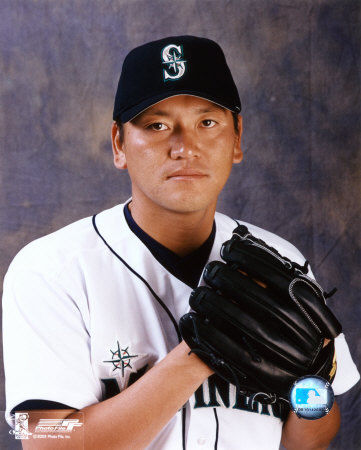
Closer: Kazuhiro Sasaki
Sasaki only played four major league seasons, all with the Mariners, and this was his first and possibly, his best. Kaz was the American League Rookie of the Year in 2000, and for good reason, as he posted 37 saves in 40 chances. Sasaki was the undisputed ninth inning guy, as he made 63 appearances and finished games in 58 of those. In just his first season, Sasaki showed why he’s widely considered the best closer in team history.
Best Reliever: Sasaki or Jose Paniagua
WAR actually favors the usually-maligned Paniagua as the Mariners’ best reliever in 2000. He, Arthur Rhodes and Jose Mesa held down the setup duties behind Sasaki, and while Rhodes led the team in holds with 24 to Paniagua’s 14 and Mesa’s 11, Paniagua was the most effective pitcher, posting a 3.47 ERA and mixing in five saves when Sasaki wasn’t preferred.
Others of note: Rhodes, Mesa, Robert Ramsay
Rhodes and Mesa were both extremely well respected relievers that pitched in the majors for a long time, but neither had their best seasons with the 2000 Ners. Mesa, who posted a 4 WAR season and finished second in the Cy Young at his apex in 1995, was below replacement-level in 2000. This was Ramsay’s final MLB season, one of only two he played, and he was solid in middle relief, posting a 3.40 ERA in 50 innings over 37 appearances. I know literally nothing else about him.
Combined WAR of top 5 relievers: 3.9
This bullpen was a solid, steady mix of guys in their late 20s and early 30s. They definitely made the team better overall, but paled in comparison to the unit that would shine the following year.
2001
It’s the golden year in Mariners’ history, the best regular season in baseball history, and, perhaps unsurprisingly, a great group of relievers.
Closer: Sasaki
Kaz was one of 8 all-stars for the Ners. He had a career-high in saves in 2001, posting 45 in 52 chances. He took the mound 69 times and finished the game in 63 of those appearances.
Best reliever: Rhodes
Arthur Rhodes was a monster in 2001. He had a career-high 31 holds and posted a 1.72 ERA in 71 appearances in the middle of the steroid era, which is absurd. In 68 innings, he struck out 83 and walked just 12. He was also randomly 8-0, which is an extremely odd win-loss record for a set-up man, but impressive no matter how arbitrary you feel wins are. Bottom line: Rhodes was a sure bet to lock down the eighth inning in a close game.
Others of note: Nelson, Charlton, Paniagua, Ryan Franklin
General Manager Pat Gillick improved on an already solid unit from the year before, by bringing key components of the 1995 bullpen back into the fold with Nelson and Charlton. Nelson, who had just won four championships with the Yankees, was an all-star for the first and only time in his career and had his final season as an elite reliever, with a 2.76 ERA in 69 appearances. It was Charlton’s last gasp as a major leaguer, as he made just 44 appearances but was serviceable, with a 3.02 ERA in 47.2 innings.
Paniagua took a step back with a 4.36 ERA in 66 innings and became a below replacement-level reliever after two years where he was decidedly above that level. It was Franklin’s first full major league season, and he showed his future all-star potential, with a 3.56 ERA in 38 appearances.
Combined WAR of top 5 relievers: 5.1
The WAR number doesn’t really tell the whole story, as this team was so much more than it’s bullpen. However, if you sub out Franklin for Paniagua, the number rises to 6.2 WAR, which makes it comparable with 1995’s valuable group.
. . .
Pause for perspective. Thus far, the leaders in the clubhouse are 1995 and 2001, with 1997 eliminated as abysmal and 2000 not quite up to snuff. But still, none of the WAR numbers are crazy good, and I’m not sold on any of these units as critical to the teams’ success.
So where to next? Since many of the players in the 2001 bullpen stayed with the team, it makes sense to look next at 2002 and 2003.
2002
A year after the magical 116-win season, the Mariners swapped out Paniagua and Charlton for Shigetoshi Hasegawa and a big role increase for Franklin, who would eventually join the rotation and make 12 starts. Sasaki had arguably his worst season as the team’s full-time closer, converting 37 of 45 saves. He did post a career-best 2.52 ERA though.
Rhodes had his career year by WAR, posting an absurd 2.7 in 66 appearances and adding in 27 holds. The bullpen won a ton of games for the 2002 Mariners, with Rhodes winning 10, Hasegawa 8 and Franklin 7, although some of those were from when he became a full-time starter in August.
Nelson had an OK age-35 season, posting a 3.94 ERA in 41 appearances and recording 12 holds, although his best days had clearly passed him by.
Combined WAR for top 5 relievers: 6.9 (nice)
All that said, the five primary guys in this bullpen actually had a higher combined WAR than any of the Mariners’ four playoff teams. Rhodes’ career-high 2.7 was a huge factor in that, plus all five were above replacement-level, although Franklin was certainly helped by becoming a starter. It wasn’t enough to get the Ners to the playoffs though.
2003
This year is more known for the absurd feat of the rotation, where every Mariner starter won at least 11 games and the five men stayed healthy all year, with no one outside the opening day rotation making a start.
The bullpen was powered by all-star setup man and eventual closer Hasegawa, who went on to post a bonkers 3.2 WAR. Hasegawa became the closer when Sasaki went down for two months in early June, and Sasaki would never record another save. Hasegawa converted 16 saves in 17 chances.
Nelson and Rhodes remained around Hasegawa in support, but neither had the elite season that they were accustomed to. The Ners flipped Nelson back to the Yankees for Armando Benitez on Aug. 6.
The real support for Hasegawa came from a pair of young relievers, Julio Mateo and future all-star Rafael Soriano. Rhodes remained the 8th inning guy, but Mateo and Soriano were more effective, with Mateo eating 85.2 innings in just 50 appearances and posting a 3.15 ERA and Soriano making 40 appearances and allowing just nine earned runs in 53 innings.
Combined WAR for top 5 relievers: 7.2
By WAR, this is the best bullpen I’ve considered so far, with Hasegawa being the major reason. While this team also fell short of the playoffs, I think this bullpen eclipses the other five units.
So weirdly, even though these past two teams missed the playoffs, they had better bullpens. And yet not even these teams had the best bullpen of the Mariners’ modern era.
That honor belongs to an obscure-yet-successful team that many Mariners fans probably don’t remember all too well. The 2009 team had Ichiro and Griffey getting carried off the field, while the 2014 and 2016 teams made legitimate runs at the wild card…but what about 2007?
2007
This certainly isn’t a super significant year in Ner lore. It’s best known for Mike Hargrove’s weird resignation when the team was 45-33 and John McLaren’s inability to push them over the top as his replacement.
Still, it’s one of the best seasons the team has had since its heyday, with the team going 88-74, but missing the playoffs in a top-heavy American League by six games. And a major reason why they got to that point was the bullpen, specifically the fire-breathing closer, J.J. Putz.

Putz was a 4 WAR closer in 2007. For context, Zach Britton went 47-for-47 in saves in 2016, finished fourth in the Cy Young, 11th in the MVP voting and had a 4.3 WAR season. So suffice it to say, Putz was incredible.
It was his second year as the Mariners’ full time closer, and he finished 13th in MVP (not Cy Young, MVP) voting after converting 40 out of 42 save opportunities. He had a 1.38 ERA and led the league in games finished with 65.
And lest you think this bullpen was all about Putz, he had a stellar supporting cast around him, lead by setup man George Sherrill, who had 22 holds and a 2.36 ERA in 73 appearances. It was the only season of his career (including his all-star 2008 as the Orioles closer) where Sherrill posted a WHIP below 1.00.
Beyond Sherrill, the bullpen had a number of good young arms in middle relief roles. Sean Green had his career year, with 13 holds and a 3.84 ERA in 68 innings. And in their early 20s, Brandon Morrow, Eric O’Flaherty and even The Hyphen, Ryan Rowland-Smith, were stellar contributors.
Combined WAR of the top 5 relievers: 8.6
Putz, Sherrill, Green, Morrow and O’Flaherty, combined to make 2007’s bullpen a truly elite, game-changing force. And yet even though they posted the best bullpen WAR in M’s history, this team did not go to the playoffs.
. . .
So even though last year’s Indians and Cubs had elite bullpens, it doesn’t appear that the best Mariners teams have had the best bullpens. It’s fair to point out that Cleveland and Chicago were about far more than their bullpens, especially in the regular season, but the relievers really took over in the late stages of the postseason.
And maybe that best explains the Mariners’ success relative to their relievers. They’ve never made the playoffs with an elite bullpen, but the two best bullpens they brought to the playoffs, 1995 and 2001, made it to the ALCS, while the inferior units lost in the divisional series. Stronger units like 2002, 2003 and especially 2007 never got the chance to flourish in high-leverage postseason situations.
If you could stick 2007’s bullpen on one of those playoff teams, maybe they could have achieved similar feats that the 2016 Cubs and Indians did.
And even though the 2017 Mariners don’t appear to have the strongest bullpen, the historically great Mariners teams only needed one or two solid arms to get over the hump and play meaningful October baseball. So maybe if the Mariners start hitting consistently – especially with runners in scoring position – they don’t need much from their bullpen to break their postseason drought.


Comments